New resource: Evaluation of Humanitarian Action Guide
ALNAP has recently released their Evaluation of Humanitarian Action Guide.
The guide was six years in the making and contains detailed advice and tips on evaluating humanitarian action. Even if your focus is not on evaluating humanitarian activities, Chapter 17 on Communicating and Reporting Findings and Results is well worth a read.
8 golden rules for communication evaluation
The UK government’s Communication Service has produced a framework for evaluating communications (pdf).
The framework provides an overview of an integrated approach to evaluating communication activities and sets out eight golden rules for communication evaluation:
1. Se t SMART objectives well before the start of your activity
2. Think carefully about who your target audience is when selecting relevant metrics from each of the five disciplines*
3. Ensure you adopt an integrated channel approach when evaluating your communications activity
4. Collect baselines and benchmarks where possible
5. Include a mix of qualitative and quantitative evidence
6. Regularly review performance
7. Act on any insight to drive continuous improvement and inform future planning
8. Make the link between your activity and its impact on your organisational goals or KPIs
*Media, digital, marketing, stakeholder engagement, internal communications
Are there any more to add? I would add the need to integrate evaluation within the daily work of communication professionals – so it is thought about before starting activities and during…
View the complete guide here (pdf)>>
My PhD on communication evaluation in 10 slides…
Earlier this year I had the opportunity to present the findings of my PhD in 30 minutes (!) to the Geneva Communicators Network. I titled my presentation “communication evaluation: challenges and complexities” – and you can view it below – it’s a very summarised version of my PhD! If you are really keen, you can view the full PhD thesis here.
New UN SG: “we need a culture of evaluation”
The new United Nations Secretary General Antonio Guterres in his “audition” speech highlights evaluation, saying:
“We need a culture of evaluation – independent and real time evaluation with full transparency”
Couldn’t agree more! Watch below at about 2.50 minutes…
Useful tool: checklist for quality of evidence
I came across this checklist tool (pdf) from BOND, the UK NGO network on quality of evidence in evaluation. I find the checklist a useful way of…well…checking…an evaluation report to assess it’s quality of evidence. It’s based on five principles: voice and inclusion, appropriateness, triangulation, contribution and transparency. As an evaluator, I will try using it myself to “check” the evaluation reports I author…
View the checklist here (pdf)>>
UN webinar: Communications and Evaluation Use, 8 November, 2016, 9.30 am EST (USA)
Here is a very interesting webinar presented by the UN Evaluation Group on communications and evaluation use;
— Communications and Evaluation Use, 8 November, 2016, 9.30 am EST (USA)
They have also produced a working paper on the subject:
How can communications improve engagement with evaluation users, and eventually increase evaluation use?
How can evaluators improve communications to increase evaluation use?
Please join us on 8 November to hear views from evaluators and communication experts from UN Women, the Global Environment Facility (GEF), and the World Bank.
You are cordially invited to attend a UNEG webinar on “Communications and Evaluation Use”. This webinar is organized by UNEG working groups under Strategic Objective Two for Use of Evaluation.
When: Tuesday, 8 November, from 9:30 to 10:30 am (New York time).
Speakers:
Marco Segone, Director, Independent Evaluation Office of UN Women, and Alexandra Capello, Evaluation Specialist, Independent Evaluation Office of UN Women
Geeta Batra, Chief Evaluation Officer and Deputy Director, Independent Evaluation Office of the GEF, and Kseniya Temnenko, Knowledge Management Officer, Independent Evaluation Office of the GEF
Daniel Musiitwa, Senior Communications Officer, Independent Evaluation Group of The World Bank, and Kristen Milhollin, Online Communications Officer, Independent Evaluation Group of The World Bank
Tracking Use of Campaign Evaluation Findings
This week I made a presentation at the European Evaluation Society conference on a tracking study on the use of campaign evaluation (that I had carried out). For those interested in this subject, my slides are here for your consumption!
Using cartoons to communicate on evaluation
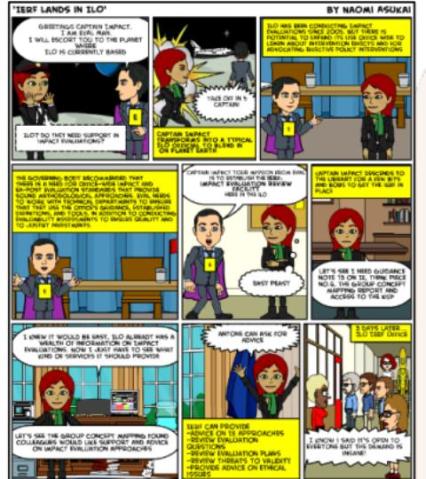
Here is a great example (pdf) from the ILO evaluation office of using cartoons to explain an evaluation process / service; it just shows that visual methods can also be used to explain evaluation processes and services – in addition to communicating evaluation results.
Network analysis and evaluation
For those interested in the use of network analysis for evaluation, here is an interesting article using network analysis to show how organisations worked together in advocacy and information sharing.
Integrated evaluation framework
The industry association, AMEC has released their new “integrated evaluation framework“, specifically designed for communications and PR:
“The integrated evaluation framework will guide you through the process from aligning objectives to establishing a plan, setting targets and then measuring the outputs, outtakes, outcomes and impact of your work.”
The new framework also comes with a taxonomy that describes for each step of the process the key steps required, the metrics and milestones and the methods that should be considered.
 intelligent measurement