Posts filed under ‘communicating evaluation results’
EU communication evaluation toolkit
The European Commission has released a communication evaluation toolkit (pdf). Produced by the Directorate General for Communication, the kit provides a very good overview of evaluating communication activities and also provides individual fact sheets on evaluating events, social media, publications, newsletters, conferences, websites and even smartphone apps…
View the manual here (pdf)
Interested in more communication evaluation toolkits? see my earlier post for five more toolkits or handbooks.
New online course: Effective and Creative Evaluation Report Writing
I’m happy to announce my new online course on effective and creative evaluation report writing. In this course, you can learn best practices for effective and creative report writing specific to evaluation reports. Learning points and practical exercises are combined to develop skills in putting together an effective and engaging evaluation report.
The course comprises of reading materials, video lectures and practical exercises to ensure practicality of the knowledge acquired. Case studies throughout the course are used to ensure the hands-on approach and development of practical skills in report writing. Checklists, tips and templates are provided to the students for usage in their own report writing.
The course is self-paced and can be completed over 5 weeks; cost is USD $375; The course is presented by TRAASS International and the trainer is myself! Further information>>
See the promotional video here:
Evaluating communication – 4 of 4 key lessons
In my last post I wrote about the third of four key lessons on evaluation for communicators.
My first lesson was “1. Planning is key”
My second lesson was “2. Decide what and how you will measure”
My third lesson was: “3. Find the time & budget to monitor and evaluate”
And my forth lesson is: “4. Analyse and share your results”
Too often, evaluation and monitoring data is not analysed; I’ve seen many media monitoring reports, web statistics and event feedback forms not compiled and analysed – communicators should be looking at such data to help understand what has been achieved (or not) and how activities could be improved. Once data is analysed, you should then see how such findings can be shared with your colleagues and stakeholders. Evaluation findings will be of interest to yourself as they concern your activities but they may also be of interest to others in your organisation and possibly externally (confidentiality taken into consideration).
Evaluating communication – 3 of 4 key lessons
In my last post I wrote about the second of four key lessons on evaluation for communicators.
My first lesson was “1. Planning is key”.
My second lesson was “2. Decide what and how you will measure”
And my third lesson is: “3. Find the time & budget to monitor and evaluate”
Today, communicators have the tools available for communication evaluation. Presuming you’ve decided “what” and “how” to measure, then the challenge is finding the time and budget to monitor and evaluate! Imagine your time and resources as a lemon (sorry, I know communicators are all squeezed for time and budget…) – and ideally you should be spending 10% on strategy; 80% on implementation and 10% on evaluation.
I’d say most communicators are not doing this – they spend 5% on strategy, 95% on implementation and 0% on evaluation. So this lesson is all about re-allocating your time and resources – I’m not saying you need to squeeze even more out of that lemon, just squeeze it more evenly..!
Evaluating communication – 2 of 4 key lessons
In my last post I wrote about the first of four key lessons on evaluation for communicators.
My first lesson was “1. Planning is key”.
My second lesson was “2. Decide what and how you will measure”
If you have planned well your communication actions, then you should have clear and measurable objectives. Your “what” to measure should normally be based at the level of objectives and their outcomes – not at the level of activities. For example, if you have set your objective as ” to put issue XY on the agenda of AB organisation” you should be measuring this notion, that is, is the issue on the agenda of AB- and not the activities and their outputs to reach this, which could be a series of meetings, events, etc.
So if you have a broad communication action you might have to narrow down the “what” you want to measure – of course, I’d recommend going for the more significant – assessing if an issue is on the agenda is more significant than assessing how many people attended a given event contributing to this goal (the former being a “outcome” and the latter being an “output”).
The “how” to measure has perhaps attracted the most attention in communication evaluation. There are plenty of guides and handbooks available that focus on the methods and tools to use to measure, here is a list of several that I find good. Key is to finding the tool/method that suits what you want to measure. For the above example, how could you measure if “issue XY is on the agenda of AB”? This could be done by studying public statements by AB on the given issue and assessing to what extent it is on their agenda.
Next post, lesson 3!
Visual summaries of evaluation reports
In commu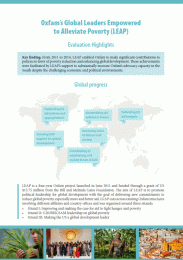 nicating evaluation findings, challenges are often seen with the key product to do so – the evaluation report. Often evaluation reports suffer from being long, wordy and just plain boring! Therefore, we have to find new ways to communication evaluation findings.
One way I find interesting is the use of a visual summary of findings – that summarises the evaluation findings graphically and in a limited number of pages. I recently had the opportunity to use this format for an evaluation for Oxfam – as seen in the image in this post. You can view the full summary by clicking on the image (it brings you to a pdf file).
6 ideas for displaying qualitative data
In a recent blog post, Ann K. Emery sets out 6 great ideas for displaying qualitative data:
- Word clouds
- Showcasing Open-Ended Survey Data Beside Closed-Ended Data (see example below)
- Photos Beside Participants’ Responses
- Icons Beside Descriptions and Responses
- Diagrams to Explain Concepts and Processes
- Graphic Timelines
Example of point 2 from Anne K. Emery:

Four challenges and opportunities for communicating evaluation findings
I’m currently in Uganda where I’ve been conducting a workshop on “communicating evaluation findings effectively” as part of the GIZ project on Evaluation Capacity Development in Uganda.
I also made a presentation for the Uganda Evaluation Association as part of their Kampala Evaluation Talk series, focusing on “Four challenges and opportunities to communicating evaluation finding” which can be seen below.
Thanks to the participants of both the workshop and the talk for their enthusiasm and interest!
This week is AMEC measurement week – plenty of interesting activities and events!
This week, 15-19 September, 2014, a new week-long campaign has been launched to highlight the importance of measurement in communications by AMEC, the communication evaluation industry association.
Check out the activities and events happening globally here>>
Presenting evaluation data effectively
For those interested in presenting evaluation data effectively, here is a recent post from Nick Herft on the BetterEvaluation blog with some very useful tips and guidance.
 intelligent measurement