Posts filed under ‘Communication evaluation’
Updated Barcelona Principles for communication evaluation
A major milestone in communications evaluation has been the Barcelona Principles, now updated for its fourth version. Led by the International Association of Measurement and Evaluation of Communication (AMEC), the Principles focuses on the seven key standards and best practices to follow. The infographic below shows the sumarised version, read more here>>

Will AI improve our ability to measure communications?
The Global Communication Report from USC Annenberg has been published. An annual global survey of communication professionals, normally the report has a strong focus on communication measurement and evaluation. This year’s edition “Mind the Gap” only has one mention on measurement – it found that 24% of communication professionals thought that the ability to measure the impact of public relations will greatly improve because of AI (the smaller numbers in the chart represent demographic splits from Millennials to Boomers).
That’s only one quarter of communicators – personally I think it will improve our ability to measure the impact of communications – perhaps not “greatly” though – that remains to be proved!
Download the report here (download is free but you need to register)

Communication evaluation at WHO
Here is an excellent article from Prof. Jim Macnamara on communication evaluation at WHO. He was part of a team which worked with WHO over a number of years to improve their communication evaluation, also over the period of the COVID-19 pandemic. it provides useful insights for anyone interested in communication evaluation and the challenges (and solutions) in this area for large global organisations today.
View the article here>>

Communication indicators – inputs to impacts
The European Commission has an interesting 1-pager from 2022 on possible indicators for communication activities- splitting indicators by type of activities (e.g. websites, events, social media, etc.) – it’s a handy guide if you are looking for indicators for specific communication activities.
View the 1-pager here>>

November is communication evaluation month!
November is communication evaluation month – AMEC, the professional association is hosting a range of free events, open to all, see the full agenda here.

New resource: The communicators guide to research, analysis and evaluation
The Institute for Public Relations has produced an excellent new guide: “The communicators guide to research, analysis and evaluation“.
The guide highlights:
“The importance of communication research, analysis, and evaluation continues to grow due to the pace of change in the marketplace and the corresponding need to make smarter and better decisions at the speed of business. The ability for an organization to successfully transform during this time of dynamic change requires the active leadership of the Chief Communication Officer and the application of talent and technology to perform the work, measure its impact, and improve at each stage of the public relations process.”
View the guide here>>
Are communicators measuring the right things?
Here is an interesting post summarizing a 2021 roundtable discussion from the US-based Institute of Public Relations on “Are PR Pros [communicators] measuring the right things?”. Some highlights from the discussion:
“Katie Paine (Paine Publishing): All the things that we have traditionally measured don’t seem as valuable today.–Long ago, the “Grammy of Communications” went to the person who got the most impressions and reported the most hits or clicks or whatever. That’s not going to happen today. I don’t know a lot of organizations that measure on that. Generally, they’re measuring on some kind of change, whether it’s increased awareness, or increased traffic, or saving lives.“
“Elizabeth Rector (Cisco): I think it’s an “and.” I think some of the standard metrics aren’t going away, it’s just multiplied, and then we are asking how they come together. That’s blowing up in my world. And finding comms people…finding people who can have that mindset and that blend, because most of my kind of comms insights people have been very much traditional comms, and some of the outcome, like the reputation and brand and all of that. But as we’re getting into thought leadership, and driving to the website, and views, and paid media that’s all now under comms’ umbrella.”
“Joseph Czabovsky (University of North Carolina): I don’t think the fundamentals have changed. As you were saying Katie, it’s still the different elements of funnel, or whether we’re doing awareness, attitude, or behavior, essentially. I think that’s still the core of what we do and what we measure“.


Campaign evaluation case study
Here is an interesting case study presenting an evaluation of a European-wide smoking cessation campaign (in other words, trying to get people to stop smoking) that I was involved with. Some interesting findings on campaigns and results in this challenging area.
Webinar – what PR metric should I measure? 25th November 2020, 12.30 GMT
As part of the AMEC* Measurement Month, I am speaking as part of a webinar, please join us:
Webinar topic: Ask the Expert: What PR metrics should I measure?
Summary: Join members of the AMEC European chapter for a interactive Q&A discussion on the metrics that really matter. Ask our panel of Europe’s leading experts anything you like about metrics. From how they choose what to measure to the pros and cons of different metrics and what makes a good report.
Speakers:
Dr. Glenn O’Neil, Founder, Owl RE
Dr. Maya Koleva, Head of Research and Insight, Commetric
Dr. Martin Löser, Managing Director Insights, Kantar Media
Date: 25th November 2020, 12.30pm GMT
Register here: https://zoom.us/webinar/register/4416028451632/WN_LvsxNzJoS7-dHssPdZu8gw

*AMEC: International association for the measurement and evaluation of communication
Barcelona Principles 3.0 – communications evaluation
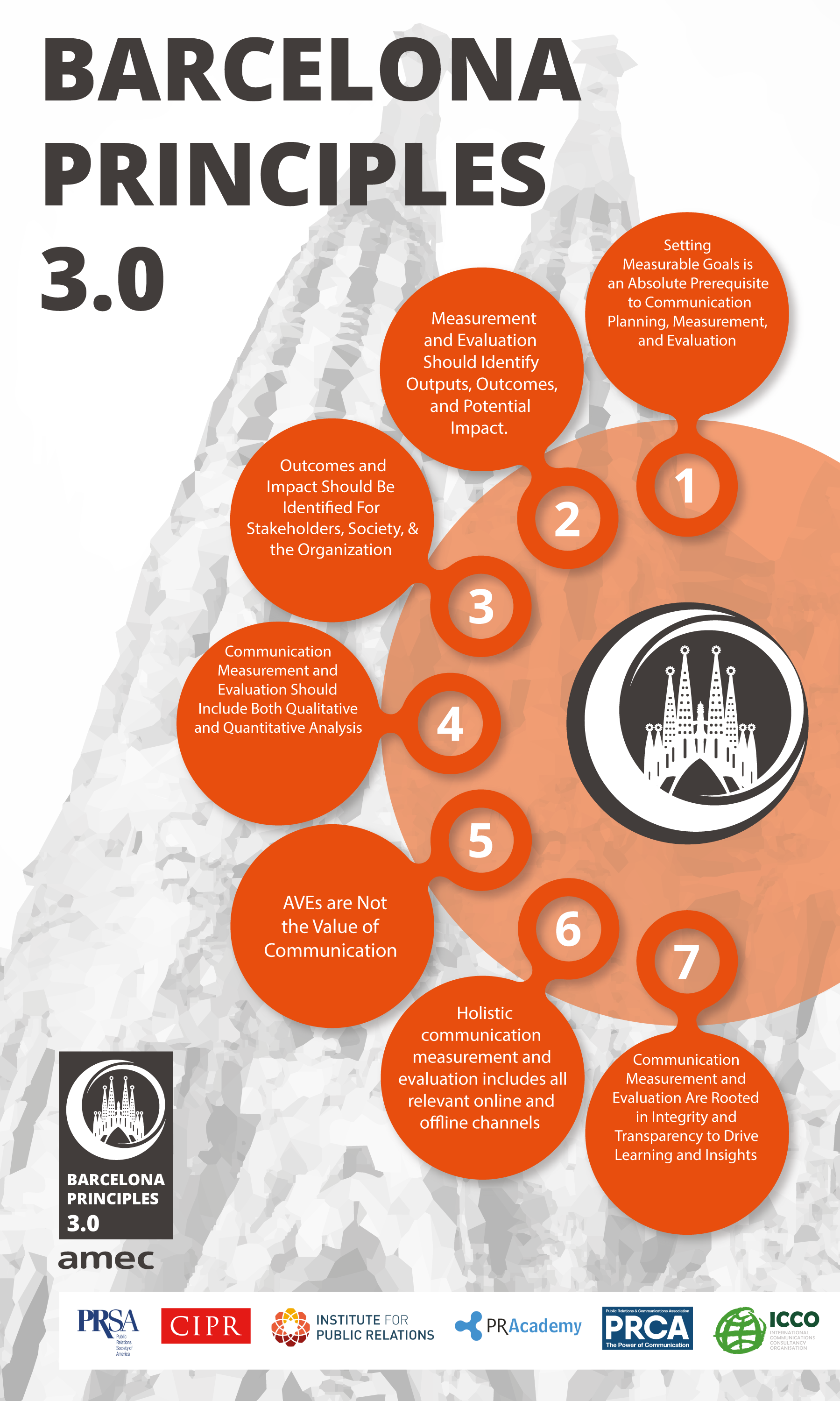
The Barcelona Principles – which set out the main principles for communication evaluation – have been updated – version 3.0.
Following is an explanation provided by AMEC.
1. Setting goals is an absolute prerequisite to communications planning, measurement, and evaluation.
The founding principle of SMART (specific, measurable, actionable, relevant, and time-bound) goals as a foundation for communications planning has been promoted to an essential prerequisite. It pushes measurement and evaluation as a core component of the planning process, articulating target outcomes and how progress towards these will be assessed.
2. Measurement and evaluation should identify outputs, outcomes, and potential impact.
Previously, the Principles recommended measuring outcomes, rather than simply counting outputs. The updated principles extend this to consider longer term impact of communications strategy.
3. Outcomes and impact should be identified for stakeholders, society, and the organization.
From the original focus on business metrics, such as sales and revenue, the 2020 update embraces a more holistic view of performance. It allows the model to be more inclusive of a broader range of organisations and communications roles that are not necessarily profit-driven.
4. Communication measurement and evaluation should include both qualitative and quantitative analysis.
“To understand the full impact of your work, it is crucial that you use the full suite of methods to measure those outcomes,” summarised Ben Levine AMEC Board Director in describing the evolution of this principle to not just quantify but also understand how messages are being received, believed and interpreted.
5. AVEs are not the value of communication.
The message remains consistent and clear; “we continue to believe that AVEs do not demonstrate the value of our work.” It is important that communications measurement and evaluation employs a richer, more nuanced, and multi-faceted approach to understand the impact of communications.
6.Holistic communication measurement and evaluation includes all relevant online and offline channels.
Our founding principle that social media can and should be measured is so obvious today. The 2020 iteration reflects the game-changing shift in social communications’ capabilities, opportunities, and influence, such that all relevant online and offline channels should be measured and evaluated equally. The AMEC measurement framework promotes clarity across earned, owned, shared, and paid channels to ensure consistency in approach towards a common goal.
7. Communication measurement and evaluation are rooted in integrity and transparency to drive learning and insights.
Sound, consistent, and sustained measurement calls for integrity and transparency in recognition of today’s attention to data privacy and stewardship as organisations comply with new regulations, such as GDPR. This is also a statement that measurement isn’t simply about data collection and tracking, but about learning from evaluation and applying insight back into communications planning. It recognises the need to be transparent about the context in which programmes are run and being aware of any bias that may exist in the tools, methodologies and interpretations applied.
 intelligent measurement