Posts filed under ‘Communication evaluation’
Standardization in Public Relations Measurement and Evaluation
David Michaelson and Don W. Stacks have published a new article on the need for standardization in PR measurement and evaluation, here is a summary:
As the public relations profession continues to focus more and more on outcomes associated with campaigns or public relations initiatives the question of standards has shifted to the forefront of discussions among and between professionals, academics, and research providers. Making this shift even more important to establishing impact on business goals and objectives is the fact that standardized measures for public relations activities have never been recognized. Unlike other marketing communications disciplinesi, public relations practitioners have consistently failed to achieve consensus on what the basic evaluative measures are or how to conduct the underlying research for evaluating and measuring public relations performance.
North American Summit on Measurement, September 18-20, 2011
The annual North American Summit on communication/PR measurement is coming up in September 2011:
Since it began in 2003, the North American Summit on Public Relations Measurement has enjoyed an international reputation for being one of the world’s leading annual conferences about research, measurement and evaluation in communications and public relations.
Each year this event features a number of unique, hands-on pre-conference workshops along with a day and a half of superb program sessions focusing on how measurement is being used effectively throughout the communications industry. This measurement summit is also noted for having several superb networking events where attendees have opportunities to exchange insights with international experts.
Through lectures, case studies and interactive discussions led by some of the world’s most noted measurement experts, the North American Summit on Public Relations Measurement annually exposes conference delegates to innovations, methodologies and best practices from some of the world’s most successful public relations measurement programs.
The communication evaluation challenges for 2020?
 At the recent AMEC Measurement Summit participants voted on what they believed should be the top priorities for communications evaluation until 2020. The top five priorities (ranked) were:
1. How to measure the return on investment (ROI) of public relations
2. Create and adopt global standards for social media measurement
3. Measurement of PR campaigns and programmes needs to become an intrinsic part of the PR toolkit
4. Institute a client education program such that clients insist on measurement of outputs, outcomes and business results from PR programs
5. Define approaches that show how corporate reputation builds/creates value.
Well, no.1 I feel is not going to be an easy one, given the diverse opinions on the issue. No. 2 merits attention but I believe “standards” for measuring social media may be a pipe dream (for me, it all depends upon what you want out of social media which in turn determines what you measure). No. 3 certainly makes sense, although we heard at the AMEC summit the main obstacle to having evaluation in the PR kit is fear of PR agencies loosing part of their budgets to evaluation…No. 4 I would fully support and No. 5 I believe there is already interesting work being done.
Read more on the AMEC website>>
Advocacy impact Assessment Guidelines
Here is an interesting fact sheet from CABI.org – “Advocacy Impact Assessment Guidelines” (pdf).
The fact sheet provides a very good summary of evaluating advocacy actions – the “how” and “what” to evaluate. It also highlights some key points to keep in mind, summarised here:
- Different stakeholders will have different views on what success is;
- If you cannot prove impact, be satisfied with a critically informed assessment of change;
- Include subjective criteria, (i.e. what successes people feel have taken place but cannot substantiate with evidence);
- Break down your advocacy intervention into manageable components;
- Be practical, yet flexible. The external environment in which your advocacy takes place will be changing all the time;
- Monitor changes in your strategy itself;
- Collaborative advocacy means that individual contributions cannot be separated from the success of the whole effort;
- Share evaluation results with a wide range of people to show the disbelievers that advocacy can work and to motivate those who have been involved.
View the fact sheet here (pdf) >>
Best practice guide for using statistics in communications
A new publication from the UK-based CIPR on using statistics in communications, key points covered include:
- Why statistics are used
- What statistical information should include in PR activities
- Analysis
- Reporting on survey methodology
- What common statistical terms mean – and pitfalls to watch out for
- Common pitfalls that can undermine your message
Employee engagement is cool. Employee surveys are not
Using Google Analytics to track the relative value of your Offer
Some lessons for the communications Evaluation profession
It is some time since I looked at my Google Analytics account. A pity, because it can reveal some dramatic insights into global trends. And the quality and mine-ability of the data is improving month by month.
I wanted to see what was happening in Benchpoint’s main market place, which is specialist on line surveys of employee opinion in large companies. So I looked up “employee surveys”. I was surprised (and shocked) to see that Google searches for this had declined since their peak in 2004 to virtual insignificance.

Google searches for "Employee Surveys"
This was worrying, because our experience is that the sector is alive and well, with growing competition.
On the whole, we advise against general employee surveys, preferring surveys which gain insight into specific areas.
So I contrasted this with a search for “Employee Engagement”, on its own. The opposite trend! This search term has enjoyed steady growth, with the main interest coming from India, Singapore, South Africa, Malaysia, Canada and the USA, in that order.

Google searches for "Employee Engagement"
“Employee engagement surveys”, which first appeared in Q1 2007, also shows a contrarian trend, with most interest coming from India, Canada, the UK and the USA.

Google searches for "Employee engagement surveys"
Looking at the wider market, here is the chart for the search term “Surveys” – a steady decline since 2007

Google searches for "Surveys"
But contrast this with searches for “Survey Monkey”
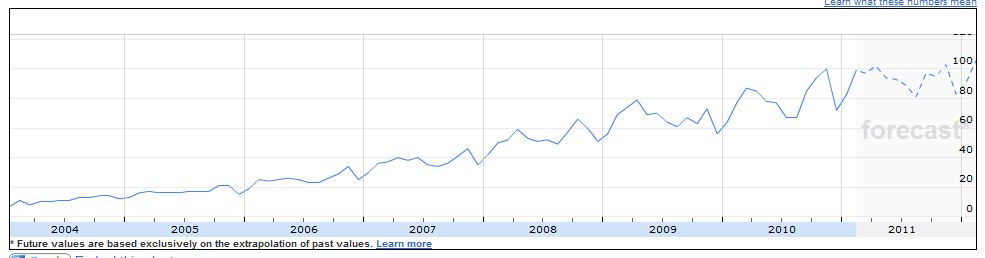
Google searches for "Survey Monkey"
Where is all this leading us? Google is remarkably good are recording what’s cool, and what’s not in great detail and in real time. There are plenty of geeks out there who earn good money doing it for the big international consumer companies. And what it tells us is that, more than ever, positioning is key.
Our own field, “ Communications Evaluation” is fairly uncool. Maybe we need to invent a new sexy descriptor for what we do?
But note, on the chart below, the peaks in the autumn of 2009 and 2010, when the AMEC Measurement Summits were held. Sudden spikes in interest.

Google searches for "Communications evaluation"
This blog and Benchpoint have the copyright of “Intelligent measurement”, which is holding its own in the visibility and coolness stake – with this blog giving a boost way back in 2007…
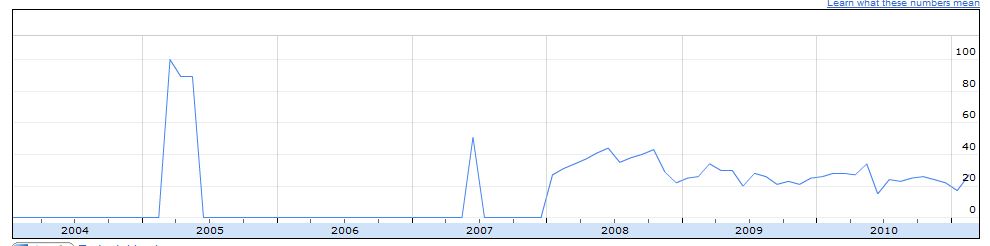
Google searches for "Intelligent measurement"
Conclusions:
- Get a Google Analytics account and start monitoring the keywords people are using to seach for your business activity and adapt your website accordingly
- As an interest group/profession, we probably need to adopt a different description of what we do if we wish to maintain visibility and influence. Suggestions anyone? Discuss!
Sorry for such a long post!
Richard
Online campaigning handbook
 Here is a newish (well I just discovered it..) online campaigning handbook (pdf) from Publiczone.
Point 10 of the handbook “Keeping track of what you are doing” focuses on monitoring and evaluating online campaigns. Here is an extract of what they recommend:
Effective monitoring and evaluation can make the difference between an average and an amazing campaign. Monitor and evaluate as you go along and you’ll keep finding new opportunities to optimise your campaigning…The trick is to design your evaluation before you start, paying close attention to how you are going to collect data. Too often, charities leave evaluation to the end, only to discover they can only form a patchy picture of their campaign due to an absence of data.
Measurement Matters – internal communications: A one-day workshop with Angela Sinickas in London
 Angela Sinickas, a US-based communications evaluation expert is conducting a one day workshop on measuring communications (with a focus on internal communications) in London.
I’ve had the good fortune to participate in a workshop with Angela and she does have an immense knowledge and experience in communications evaluation.
date: 30 November 2010
cost: 545-595 £
location: Broadway House, London.
For more information and registration>>
This event is organised by Melcrum Publishing.
(This blog has no commercial connections to Melcrum or Angela – it just looks like an excellent workshop!).
New book on PR measurement
 I’m just reading my copy of the new publication “A Practitioner’s Guide to Public Relations Research, Measurement and Evaluation“. The book, by Drs. Stacks and Michaelson is a no-nonsense guide to PR measurement and evaluation that’s well worth a read. I like how they stress the importance of “measurable” objectives and endeavour to move the focus from measuring “outputs” to “outcomes”. They recommend three steps essential for evaluating PR and communication programmes, that I summarise as follows:
– Set clear and well defined research objectives
– Apply rigorous research design that enables reliable research results
– Provide detailed documentation with full transparency
I couldn’t agree more…
You can learn more about the book here>>
Please note, this blog has no commercial interest in this publication, we just believe it’s a good read!
Barcelona Declaration of Measurement Principles – Final Version
The Barcelona Declaration of Measurement Principles for communication evaluation, which I wrote about previously, have now been finalised, here they are:
Seven Principles
1.Importance of Goal Setting and Measurement
2.Measuring the Effect on Outcomes is Preferred to Measuring Outputs
3.The Effect on Business Results Can and Should Be Measured Where Possible
4.Media Measurement Requires Quantity and Quality
5.AVEs are not the Value of Public Relations
6.Social Media Can and Should be Measured
7.Transparency and Replicability are Paramount to Sound Measurement
The explanatory text (pdf) is well worth a read as it explains the thinking behind the above principles. As I pointed out before, two out of seven principles focus on media measurement, indicating our sector’s focus in this area – what I consider a distraction from real “outcome” evaluation which communications needs.
The International Association for Measurement and Evaluation of Communication (AMEC) has set up taskforces to find the answers to two questions related to principles 5 & 6, notably:
1) What are the “validated metrics” to replace AVEs?
2) How do you get started in measuring social media, and what are the definitions of relevant metrics?
I look forward to learning more about their work.
 intelligent measurement